

Remembered as a pioneering atmospheric scientist who bridged planetary science, climate policy, and undergraduate education, Michael B. McElroy, 86, died earlier this month from cancer.
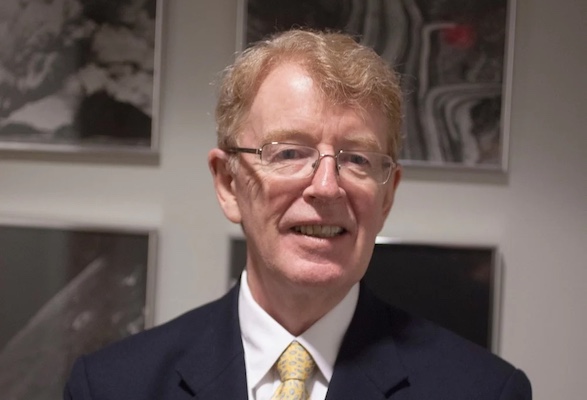
When exams rolled around, Michael B. McElroy was a force to be reckoned with.
Following one particularly brutal test in graduate school, McElroy’s classmates decided that they could only assess their own performance after hearing from the resident wunderkind. When McElroy said he also found it difficult, they rejoiced — only to find out that he’d misread the exam.
While everyone else saw that they had been asked to answer only three out of the 10 questions, McElroy had pushed through all 10.
“I thought that was so typical of him,” his wife, A. Veronica McElroy, said.
This kind of fast-paced analysis was a hallmark of McElroy’s scientific approach. Through his career, he shifted from examining planetary atmospheres in the heyday of the space race to studying human-induced climate change — including research on the ozone layer that shaped the United Nations’ Montreal Protocol in 1987. In 2024, he was awarded the American Geophysical Union’s William Bowie Medal, the organization’s highest honor.
Over the decades, he took an active role in shaping key environmental initiatives at Harvard, leading the University-wide Committee on the Environment, helping found the Environmental Science and Public Policy concentration, and spearheading the Harvard-China Project on Energy, Economy, and Environment.
In 1995, McElroy served as the chairman of MEDEA, a task force appointed by former U.S. Vice President Al Gore ’69, to use data from U.S. intelligence to better understand the environment.
Gore wrote in a statement to The Crimson that McElroy was “thoughtful and unrelenting in his efforts to advance efforts to protect the livability of our planet for future generations.”
“His work to develop and deepen ties between scientists, economists, policymakers, and academia on the greatest challenge of our lifetimes – the climate crisis – will continue to pay dividends for decades to come.” he added.
McElroy died earlier this month from cancer at the age of 86, a little over a week after officially retiring from teaching. He is survived by Veronica McElroy and their children, Brenda “Bren” McElroy and Stephen McElroy.
‘A Towering Intellect’
Born in Dublin, Ireland, McElroy received his undergraduate degree from Queen’s University in Belfast. He continued his graduate studies at Queen’s, earning a Ph.D. in Applied Mathematics in 1962 at the age of 23 and moving to the University of Wisconsin that same year.
Arriving in the U.S. amid the flurry of the space race, McElroy turned his focus to atmospheric science. As a member of the NASA Lunar and Planetary missions board, McElroy used satellite observations of Mars, Jupiter, and Venus to reconstruct the behavior of their atmospheres.
McElroy arrived in Cambridge, Massachusetts in 1970, recruited in part for his work on planetary atmospheres. At only 30 years old, McElroy became one of Harvard’s youngest tenured professors.
Because of his young age, he was often mistaken for a graduate student when he went out to lunch, according to Yuk L. Yung, a planetary professor at the California Institute of Technology and one of McElroy’s early Ph.D. students.
At Harvard, McElroy began focusing on Earth’s atmosphere and the impact of human activity. His research on the role of bromine and nitrous oxide in ozone layer depletion helped shape the 1987 Montreal Protocol, an international agreement that called on countries to ban substances that depleted the ozone layer.
“He thought about the Earth as a planet,” longtime collaborator and Harvard Atmospheric and Environmental Science professor Steven C. Wofsy said. “Today, that doesn’t sound like a particularly revolutionary idea, but back in those days — particularly when thinking about the chemistry of the atmosphere or air pollution — people really thought about it in much more local terms.”
In those years — while working on papers with Wofsy and then-postdoctoral researchers Jennifer A. Logan and Michael J. Prather — McElroy remained formidable in his scientific approach. He would spend hours physically cutting out the best sentences in a printed draft of a paper and then suturing them together with new language.
“It was the most hilarious way to write a paper,” Prather, now an earth system science professor at the University of California, Irvine, said. “We’d never seen this before.”
That intensity was one of McElroy’s many characteristic traits.
“He was a towering intellect, and I actually was always a bit intimidated by him, so when I got to Harvard, I decided I was not going to really work with him,” Environmental Science and Engineering chair Daniel J. Jacob, then a postdoctoral researcher invited to work at Harvard by McElroy, said.
“I developed a lot of independence pretty early on, and some of that rubbed him the wrong way, and we had our tiffs — but he always supported my career, and I’m extremely grateful to him for that,” he added.
‘Being Let in on the Secret’
McElroy was no stranger to scientific and academic disagreements.
When he first joined Harvard’s faculty, the Division of Applied Sciences had little room for academics like himself, who were in the less established fields of atmospheric science, oceanography, and planetary science.
To make space for these growing fields, the Earth and Planetary Sciences department was created in 1986. As the department’s founding chair, McElroy treaded uncertain waters, bridging the gap between the old and new guard of earth science.
“He oversaw this transition, and really helped create an integrated earth science program that now is kind of the standard at the top departments all over the U.S.,” geology professor Daniel P. Schrag said.
McElroy’s interdisciplinary approach profoundly shaped his interactions with Harvard politics and undergraduate education.
He chaired the University-wide Committee on the Environment starting in 1991, the same year he was shortlisted as a candidate for University president. Working in coordination with then-University Provost Jerry R. Green and other professors, McElroy helped establish the Environmental Science and Public Policy concentration in 1993.
Students and faculty alike pointed to his dedication as a teacher. He was always available to talk, they said.
Tomoki Matsuno ’25, one of McElroy’s thesis advisees, said McElroy was a gentle mentor — but knew when to double down on an idea if necessary.
“Professor McElroy was very kind, soft — generally, a really soft professor — but at the same time, he believes what he thinks, he believes what is good for students,” he said.
Inside the classroom, Wofsy said, McElroy would approach problems from the ground up — exploring the base-level mechanics of environmental science rather than feeding students big-picture overviews.
“It wasn’t just being told a story,” Wofsy said. “It was more like being let in on the secret: How does it work?”
The early years of ESPP were tense and challenging. But according to public policy professor William C. Clark, who taught the first ESPP junior seminar with him, McElroy “just had this amazing ability to not take himself — and thus not take us — too seriously.”
“That helped a lot, because it kept this from being so stressful that you ended up all hating each other, and instead, we just enjoyed having good times with each other,” he said.
Several former students said it paid off. Noelle E. Selin ’00, an earth, atmospheric and planetary sciences professor at the Massachusetts Institute of Technology and former student of McElroy’s, said his class on atmospheric chemistry convinced her to concentrate in ESPP because of its interdisciplinary focus on politics and government.
Beyond just teaching policy, McElroy also actively worked to shape it, even across international lines. The same year ESPP was established, Green worked with McElroy to create the Harvard-China Project on Energy, Economy, and Environment — a research program on China’s atmospheric environment and energy system.
While McElroy retired from teaching on Dec. 31, 2025, he planned to continue helping lead the Harvard-China Project.
This kind of commitment didn’t come as a surprise. According to Veronica McElroy, he was Crimson through and through.
“He loved Harvard, and he got from Harvard as much as Harvard gave him,” she said.
https://www.thecrimson.com/article/2026/1/23/michael-mcelroy-obituary